Why Towels Turn Hard — and How to Make Them Soft Again
A towel can look almost unchanged and still feel completely different after a few months. The loops flatten, the surface feels stiff against damp skin, and the towel seems less willing to absorb water. It is easy to assume the fabric has simply worn out. In most cases, the real cause is what has collected in and around the fibres.
The short answer. Towels turn hard mainly because detergent residue and hard-water minerals build up inside the dense terry loops. Fabric conditioner adds a coating of its own, and drying a towel flat and motionless presses the loops down. Use less detergent, skip the conditioner, add a rinse, shake the towel before drying and finish it with movement rather than heat. Build-up can usually be reversed with a single reset wash. Fibres damaged by years of very hot washing cannot.

Why do towels become hard after washing?
1. Too much detergent stays in the fabric
More detergent does not produce a cleaner towel. Modern detergents are concentrated, and an oversized dose is difficult to rinse out of dense terry loops. As residue builds up, the towel feels coated and rigid rather than clean and supple.
Dose for the actual load, the soil level and your local water hardness — not out of habit. In soft-water areas, roughly half the amount printed on the pack is often enough. If a freshly washed towel feels heavy, waxy or faintly soapy, run an additional rinse.
2. Hard water leaves mineral deposits in the loops
Calcium and magnesium in the water settle on textile fibres over time, particularly when combined with excess detergent. The result is a towel that feels rough even though it has been washed correctly in every other respect.
Water hardness varies enormously across Europe. Large parts of Ireland, the Netherlands, Belgium and Germany sit in the hard or very hard range — broadly above 14 °dH, or 250 ppm calcium carbonate — while much of Sweden and Norway is soft. Your local water supplier publishes the figure for your address, and detergent packs use it to set the dose. Descaling and cleaning the machine according to its manual matters too: a machine that rinses well is part of good textile care.
3. Does fabric conditioner ruin towels?
It does not ruin them, but it works against what a towel is for. Conditioner creates softness by leaving a fine, slightly waxy coating on the fibres. That coating is exactly what stops terry loops taking up water. With repeated use, the towel smells fresh and feels plush in the cupboard while drying you less and less effectively.
If softness and absorbency are both priorities, leave conditioner out of everyday towel washes and let the fibre, the loop construction and the drying method create the handfeel instead.
4. The washing machine is too full
Towels need room to move. In an overloaded drum, water and detergent cannot circulate and rinsing becomes far less effective. Heavy wet towels also compress one another, leaving the loops flattened.
Fill the drum to roughly three quarters rather than packing it. Wash towels with similar textiles rather than mixing them with garments that have zips, hooks or rough fastenings.
5. Does heat make towels hard — or is it the drying?
Both, but not in the way most people assume. Repeated very high temperatures do weaken cotton and viscose over time, and the hottest dryer programme can leave the surface feeling brittle.
Heat, however, is not the main culprit. Stillness is. A towel dried flat and motionless on a narrow rail dries with its loops pressed into place, which is why line-dried towels are often the stiffest of all. Movement is what lifts the pile back up. A short tumble on a moderate setting is the most effective way to restore it. If you air-dry, shake the towel firmly before hanging it, give it space and airflow, and shake it again once it is dry. Always follow the care label.
How do I make hard towels soft again?
If the stiffness comes from build-up rather than worn fibres, a single reset wash usually makes a clear difference. This is an occasional treatment, not a routine.
- Wash the towels alone, with no detergent and no conditioner. Use the warmest temperature the care label allows — commonly 60 °C for cotton and cotton blends.
- Add around 150–250 ml of white vinegar to the fabric-conditioner compartment. It is mildly acidic and helps dissolve mineral and detergent residue that a normal rinse leaves behind.
- If the towels still feel coated, run a second, separate cycle with about 100 g of baking soda added directly to the drum.
- Dry with movement. Shake each towel out, then tumble on moderate heat or hang it with plenty of air around it.
Three cautions. Keep the vinegar and the baking soda in separate cycles — acid and alkali simply neutralise each other. Never combine vinegar with chlorine bleach or any chlorine-based cleaner. And check your machine's manual: some manufacturers advise against acidic additives as a regular habit.
Be realistic about the outcome. A reset removes what has accumulated. It cannot rebuild fibres that have been damaged by years of very hot washing, harsh products or ordinary wear.
A simple routine for softer, more absorbent towels
- Wash before the first use. A first wash removes loose lint and any finishing residue left from production or packing. Wash new towels separately the first time — deep shades can release colour, and fresh terry sheds lint onto other textiles.
- Measure the detergent. Base the dose on your water hardness and the actual load.
- Wash at 40 °C for everyday loads. Reserve 60 °C for occasional deeper cleaning, and only where the care label allows it.
- Leave room in the drum. Roughly three quarters full. Towels need movement to wash and rinse properly.
- Skip fabric conditioner. It coats the loops and gradually compromises absorbency.
- Add an extra rinse when needed. Especially useful in hard-water areas, or when a towel still feels soapy.
- Shake before drying, and dry with restraint. Shaking lifts the terry loops. Use moderate heat or good airflow, and never leave damp towels folded or crowded together.
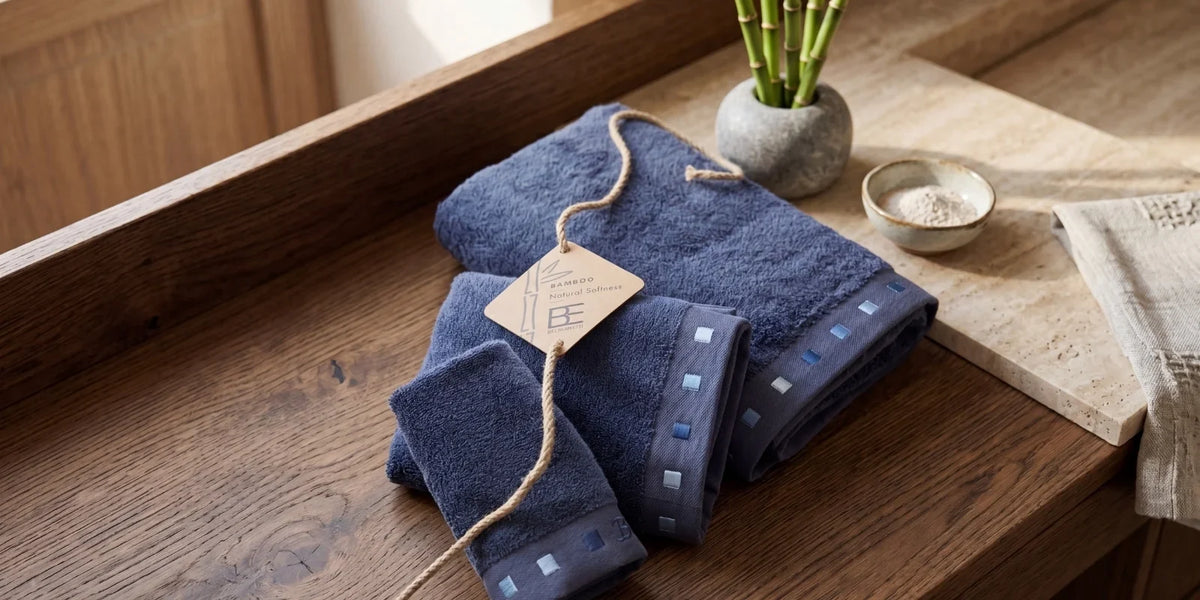
A towel that starts soft has less to recover from. The Belmanetti Bamboo-Cotton Towel is built around handfeel rather than weight — 60% cotton for structure, 40% viscose derived from bamboo cellulose for the smoother surface.
Are thicker towels better?
A premium towel should not need a heavy layer of fragrance or conditioner to feel pleasant, and luxury does not have to mean the heaviest towel on the shelf. Weight, loop construction, fibre composition and care all shape the experience.
A very dense hotel-style towel can feel impressive, but it also holds more water, takes up more room in the machine and is slower to dry on the rail. For an urban bathroom, a more balanced towel is often the better everyday luxury: soft against the skin, effective after a shower, easy to handle and simple to coordinate with the room. We looked at this trade-off in more detail in our honest comparison of bamboo and cotton towels, including what GSM actually tells you.
Why Belmanetti blends cotton with viscose derived from bamboo cellulose
The Belmanetti Bamboo-Cotton Towel is made from 60% cotton and 40% viscose derived from bamboo cellulose. The wording matters: the bamboo cellulose is processed into viscose before it becomes a textile fibre, and we would rather say so than lean on a shorter, vaguer label.
The cotton gives the terry its familiar body and structure. The viscose contributes the smoother, more fluid, velvety character of the surface. Together they create a towel designed around touch and everyday comfort rather than exaggerated weight or environmental slogans.

It is available as a face towel, hand towel and bath towel, so it can be used as a coordinated set or combined in tonal shades for a quieter bathroom. If you prefer a pure cotton terry, our cotton towel range sits alongside it.
Explore the Belmanetti Bamboo-Cotton Towel →
The Belmanetti Journal
Occasional letters on textiles, care and quiet design — written to be useful, not to sell you something. Unsubscribe whenever you like.
Frequently asked questions
How can I soften towels without fabric conditioner?
Reduce the detergent to the correct dose, leave more space in the drum and add an extra rinse if residue is likely. Shake the towels before drying and finish them with movement — a short tumble on moderate heat, or a well-spaced rail. If the stiffness comes from build-up rather than damaged fibres, a one-off vinegar reset wash usually helps as well.
Does white vinegar damage towels or the washing machine?
Used occasionally and diluted through the conditioner compartment, white vinegar is a common way to remove residue. It is not intended as a weekly additive: some machine manufacturers advise against routine acidic products, so check your manual. Never mix vinegar with chlorine bleach or chlorine-based cleaners.
What temperature should towels be washed at?
For everyday use, 40 °C is usually enough. Use 60 °C occasionally for a deeper clean, and only if the care label on the individual towel allows it. Higher temperatures used constantly shorten the life of the fibres.
Should new towels be washed before use?
Yes. A first wash removes loose lint and production or packing residues, and it improves absorbency. Wash new towels separately the first time, since deep shades can release colour and fresh terry sheds lint.
Are thicker towels always better?
No. A heavier towel may feel plush, but it also absorbs more water into the fabric as a whole, takes longer to wash and can be slow to dry in a small bathroom. The right choice depends on the balance you want between weight, handfeel, absorbency and everyday handling.
Why does a towel smell musty even after washing?
A musty smell develops when moisture stays in the towel too long. Avoid leaving used towels in a pile or sitting in the machine after the cycle, give them room on the rail, and make sure they are completely dry before folding and storing them.
Can a rough towel become permanently soft again?
Often, yes — if the roughness comes from residue or compressed loops, a reset wash and better drying habits will bring much of the handfeel back. If the fibres have been damaged by repeated high heat, harsh products or long-term wear, the change may not be fully reversible.
The quiet version of everyday luxury
A soft towel is not a decorative extra. It is something you touch every morning and evening, which is precisely why the details matter. The right fibre blend, thoughtful construction and simple care create a more refined experience without turning the bathroom into a showroom.
Keep the routine uncomplicated: use less product, rinse thoroughly, dry with movement rather than heat, and choose a towel whose softness comes from the textile itself.
Belmanetti is a European bathrobe and towel brand, part of a textile business operating since 1997. Our towels are designed in Europe and woven in Turkey. The care advice here is general guidance — the care label on your individual textile always takes precedence.